AI · SEMICONDUCTOR · FACT CHECK
 SKD WIRE
Mostly True

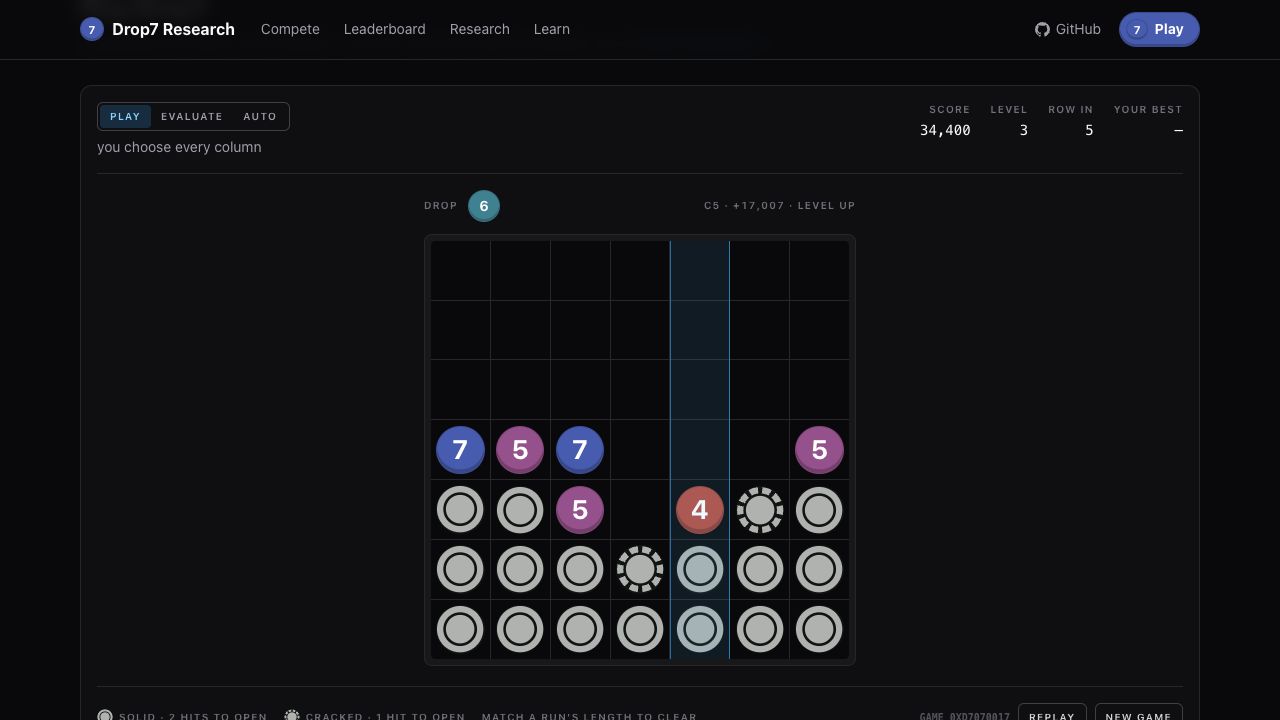
Drop7, the minimalist puzzle game built on a seven-column grid, offers players only seven possible moves per turn — yet that narrow choice space conceals a deceptively difficult problem, one that combines search, hidden information, long-term planning, and an element of chance.
At any point in a game of Drop7, the player has exactly seven options: drop a numbered disc into one of the seven columns. Discs that complete a horizontal or vertical row of the same number disappear, scoring points, while discs covered too long become cracked and eventually block the board.
Despite the small branching factor per turn, the game's difficulty comes from how those choices interact over time. Sequencing drops to set up cascading clears requires long-term planning, and the order in which discs arrive is not fully under the player's control — an element of chance that shapes every decision.
Discs that have been covered on the board are hidden from view until they are uncovered, adding a hidden-information dimension to the game. A player clearing one row may reveal discs whose values were unknown, altering the optimal plan mid-game.
This combination — a small move space, concealed board state, cascading chain reactions, and randomness in the disc sequence — turns what looks like a simple matching game into a surprisingly challenging search problem, the kind of structure that has made Drop7 a subject of interest among players and programmers studying the game.
Verdict: Mostly True