AI · SEMICONDUCTOR · FACT CHECK
 SKD WIRE
Mostly True
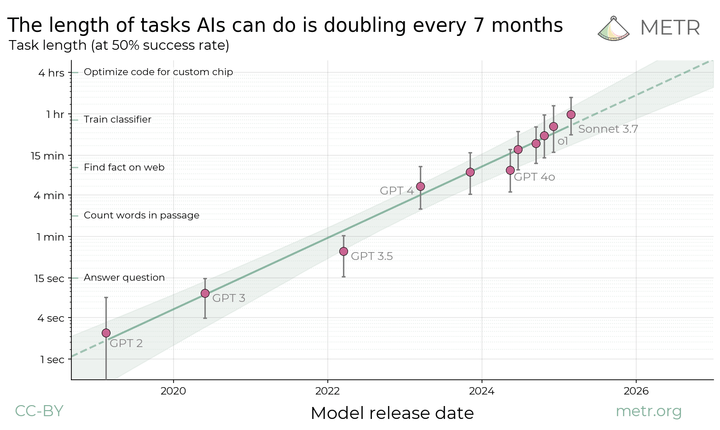
The claim that "AI is accelerating AI development" holds up as a broad assessment: AI systems are increasingly being used to speed up research tasks that feed into the development of better AI, though the evidence reviewed covers international research findings rather than specific Korean industry cases.
The central supporting evidence comes from work by METR (Model Evaluation & Threat Research), which measures AI systems' ability to complete long, complex tasks. Its published analysis of task-length trends shows that the horizon of tasks AI models can complete autonomously has been growing rapidly, a trajectory illustrated in its chart on the length of tasks models can handle.
This growing capability is the mechanism behind the claim: as models become able to carry out longer stretches of research-relevant work — coding, experimentation, and analysis — they can take on a larger share of the AI development process itself.
The general proposition that AI contributes to AI development is supported: contemporary LLMs are widely used for code generation and research assistance, which are core inputs to building newer models. The direction of the trend — AI systems handling progressively longer tasks — is consistent with AI playing an expanding role in its own development cycle.
However, the evidence base has limits. Domestic Korean-specific accounts of AI companies accelerating their own development could not be pinned down, as Naver News API searches were unavailable due to missing credentials in the verification environment. The claim therefore rests on international research evidence rather than confirmed Korean industry cases, and the precise magnitude of AI's contribution to AI R&D remains an open research question.
The claim that AI accelerates AI development is broadly supported by measurable trends in model capability, but its strength varies by context and has not been quantified for the Korean industry specifically. As an overall characterization of the current research landscape, the claim is Mostly True.
Verdict: Mostly True