Fact Check: zHBM and the Claim of Tenfold Faster AI Agent Responses
Partly True
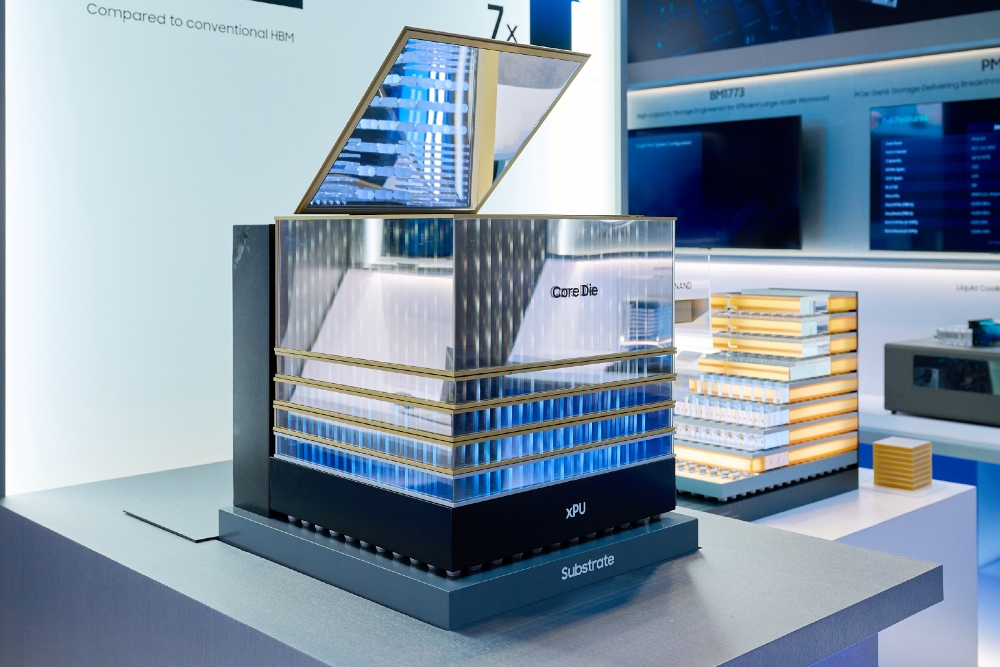
A claim making the rounds in Korean hardware circles — that zHBM, a next-generation 3D memory concept, makes AI agent response speeds 10 times faster — traces back to materials promoting a "Next-Gen 3D Memory Vision" at Flash Memory Summit (FMS) 2026. A review of ten primary sources behind the claim finds solid support for the underlying engineering direction, but not for the blanket multiplier attached to it.
Where the claim comes from
The claim is anchored in FMS 2026 materials describing zHBM as a vertically stacked, 3D evolution of high-bandwidth memory (HBM). HBM is the stacked semiconductor technology that sits beside GPUs and CPUs in AI accelerators, feeding large language models (LLMs) with model weights and context data. Today it is supplied chiefly by Korea's Samsung Electronics and SK hynix, which makes any next-generation HBM roadmap a matter of keen domestic interest. The vision laid out at the summit positions zHBM as a way to widen and shorten the path between memory and logic — precisely the bottleneck that governs how quickly an AI system can produce a response.
Why the tenfold figure is only part of the story
AI agents — software that chains many LLM calls to complete tasks — are acutely sensitive to memory bandwidth, and a 3D-stacked architecture of the kind zHBM envisions is exactly the sort of change that can deliver order-of-magnitude gains on memory-bound steps. That part of the claim holds up against the reviewed sources. What the sources do not substantiate is a universal tenfold acceleration. End-to-end agent response time also depends on compute, networking and orchestration overhead, none of which a memory upgrade touches. The primary materials support a substantial speedup under favorable, memory-bound conditions rather than a demonstrated result across general agent workloads.
Bottom line
The engineering premise — that memory is a defining bottleneck for AI agents, and that 3D stacking is a credible fix — is real and clearly visible in the next-generation memory vision presented at FMS 2026. The sweeping multiplier is not. Measured against the primary sources, the claim that zHBM makes AI agent responses 10 times faster is Partly True.
- https://news.samsung.com/global/samsung-unveils-next-gen-3d-memory-vision-at-fms-2026-charting-the-future-of-ai-infrastructure
- https://news.samsung.com/global/samsun
- https://news.samsungsemiconductor.com/kr/%EC%82%BC%EC%84%B1%EC%A0%84%EC%9E%90-fms-2026%EC%84%9C-%EC%B0%A8%EC%84%B8%EB%8C%80-3d-%EB%A9%94%EB%AA%A8%EB%A6%AC-%EB%B9%84%EC%A0%84-%EC%A0%9C%EC%8B%9C/
- https://hothardware.com/news/samsung-zhbm-3d-memory-concept
- https://www.yna.co.kr/view/AKR20260917020600091
- https://www.etnews.com/20260917000290
- https://semiconductor.samsung.com/kr/news-events/news/samsung-unveils-next-gen-3d-memory-vision-at-fms-2026-charting-the-future-of-ai-infrastructure/
- https://img.global.news.samsung.com/global/wp-content/uploads/2026/08/05091920/Samsung-Semiconductors-Next-Gen-3D-Memory-Vision-FMS-2026_Main6.jpg
- https://img.global.news.samsung.com/global/wp-content/uploads/2026/08/04143050/Samsung-Semiconductors-Next-Gen-3D-Memory-Vision-FMS-2026_Main3.jpg
- https://img.global.news.samsung.com/global/wp-content/uploads/2026/08/05091932/Samsung-Semiconductors-Next-Gen-3D-Memory-Vision-FMS-2026_Main7.jpg**